Thursday, March 25, 2010

Loop Cuts!

Cut and sew what a wonderful way to transform anything. Below is an inside look at MIO's first incursion into the world of the wearable. Below some development images and a few of the prototypes that get our blood going:

Wednesday, March 24, 2010

East & West, Not East vs. West

The tension has been brewing, the rhetoric has been building and the reality has been ignored by both sides. I am of course referring to relations between China and the US (both directly and through surrogates). The reality is that both countries NEED each other but don't want to accept this reality, and are unwilling to brush political and cultural competition aside for true economic and social gain. Instead we are witnessing the rebuilding of a modern version of the "cold war" dominated by information (intellectual property in all its forms), technology and cultural superiority. We have been here before. The outcome is wasteful, unproductive and given our current environmental, social and economic state it could prove to be deadly.

Communication is fundamental in any relationship, from the most intimate to the most corporate. That is why it is surprising to find the smartest (read logical) and most competent leaders both in China and the US deploying soviet era strategy on each other. Both sides are playing a game of chess that relies on breaking the other in ways that don't matter as much, to avoid having to make real changes that matter to everyone (China, the US and the world at large). Superficial communications and hidden agendas are disrupting what could be the most productive relationship in the short history of humanity. Imagine if these leaders sat down to really tackle the big issues at the expense of both countries political agendas. Democrats and Republicans in the US would be forced to deal with the economic decisions that have made China their bank and would have to become flexible with their isms and almost cartoon-like disputes. The Chinese leadership would have to realize that pseudo-socialism is both cultural and economic disaster in the long run, and that modern capitalism is as much about profits as it is about people first. China and the US could balance each other greatly, creating synergies beyond commerce that would alter policy and set a standard for leadership, economic prosperity and social justice that would ripple across the entire planet.

I know this sounds like idealism, but to me this is just design pragmatism. To me all problems are design problems. Most solutions require the right information and that is an impossible goal without good communication. Every problem in government could be solved with design thinking, but it would require willing partners or at least good listeners willing to edit (politics) and synthesize (make an outline for change). Unfortunately couples who don't communicate end up splitting and in many cases divorcing each other. The economic, emotional and social impact of these breakups is usually quite painful, especially for children and families. I think citizens in China and the US know that breakups are tough, but I am not certain if they fully appreciate what a breakup on this scale could mean for all the children in this planet.

Tuesday, December 22, 2009

Editing: Design by Numbers

Like contemporary musicians the job of the designer is to edit and single out the most powerful combinations. By combinations I mean design choices that have the greatest social, environmental and aesthetic value / impact. In an age when virtually any product imaginable has been designed and redesigned countless times, our role has been transformed to that of curator, co-creator, cultural engineer and ethicist.

This new role is surprisingly more complex, more rich in opportunities and more demanding of designers. What does it mean when the role of design is transformed into that of an administrator of ideas, an orchestrator and a social engineer? If in fact this is our new role what are the required skills and background required to educate and transform consumers into active participants in use, experience and collective social and environmental investment?

The tools of the past, those that give form, color and texture to objects are only a small portion of what is needed and required by our evolving culture and our fading planet. We have today the technological prowess to completely destroy our way of life in a matter of years. I prefer to think we now have the ability, responsibility and technology to stabilize markets and to begin transforming our habits, behaviors and value systems.

"We can't solve problems by using the same kind of thinking we used when we created them."
-Albert Einstein

If the above is true (as I believe it is often the case), then we must not only be guided by the tried and true, but by the statistical, factual and humane. It is time for designers to embrace ethics and statistics as strategies for goals beyond the aesthetic and utilitarian. We need to take information that was once the domain of number crunchers and marketers to use it as a solid platform for design interventions. Customer insight is not just to sell more stuff, but to create a framework that is more human-centered and that accounts for the social and environmental effects of design.

What does this mean in practice?

Design is not always about more stuff. It is about service, function and experience:
Imagine if designers stopped making new stuff and instead decided that they should help companies edit what they make and how they make it. The power of this approach has been underestimated.

Design must begin to be measured in quantifiable numbers beyond dollars:
Everyone knows that design adds value (at least those who understand the purpose of design). Expression alone or design as branding is no longer enough. Integrating design into the purpose of a business changes the business, integrating design into a business simply changes the design. Until we can make the environmental consequences a non-issue we need to realign our focus and begin measuring the impact of design on our environment and on people.

Design is for people:
People should be central to major design decisions. The ultimate goal of design should be a hybrid of sustainability and design. Perhaps something like this: "Experiences and functionality that satisfies the needs and wants of people in a specific context without compromising the ability of future generations to meet their own needs and wants."

Awareness needs to be a built-in part of the design:
Changing minds and behaviors is a tough thing, except when we build in behaviors into a design or if we are able to reward them. Awareness needs to be part of the function of a product. We need to make awareness an automatic benefit, not a warm and fuzzy excuse to buy something we don't need.

Design for the whole story:
Every story has a beginning, a middle and an end. As designers we have focused disproportionately on the beginning and the end of a products cycle. If we keep focusing on the origin of products and materials alone, or if we just worry about the "death" of products we will have missed the biggest opportunity for change. We need to design "perpetual sustainability" into products and services. Imagine if every product generated an environmental dividend each time it was used. We would certainly be on our way to building a transitional strategy for short term sustainability or even long term depending on what was being designed.

There are no magic bullets:

We need to look at as many solutions as necessary. If we are guided by the numbers we will make educated choices and in turn have a measurable impact. Design for the numbers won't lead us anywhere, design without numbers is an empty promise, but design by the numbers can bring about a whole new way to think about what we should do next.

Friday, July 10, 2009

MIO For Target

Reviewing my last posts I see that there is quite a bit missing here. Specifically our MIO for Target collaboration. Here is a bit about and some behind the scenes (after my blogophobic moment -we can thank Blogger for that-).

MIO for Target
MIO for Target was launched (a small collection of outdoor living products). The collection included the first ever composter carried at Target stores, an indoor and outdoor solar lamp (that uses the sensor as switch -turn it upside down to turn it on-), a portable hammock (the pouch turns into a hammock pocket for sweater, magazines or shoes), a molded paper pulp herb garden, a watering can made from recycled plastic and gardening tools. The collection was designed around existing vendors and focused on creating products that used existing infrastructure to create accessible sustainable design for the garden. Every product in the collection has a unique story behind it that we are very proud of, but the thing we are most proud about is the design of our first "Active Sustainable" product. I consider this one of our biggest breakthroughs in sustainable design thinking / design. Before I keep going this is how we define "Active Sustainability" at MIO:

Active Sustainability or Perpetually Sustainable Products:
Products that, by way of their design, encourage conservation. The best actively sustainable products are designed so that the stage in which the product has the greatest environmental impact is precisely when the product’s conservation attributes are most active. A product can only be considered active if it produces a positive and quantifiable environmental impact each time it is used.

Our vermi-composter and solar lights for Target are great examples of "Active Sustainability". In both instances the products function (useful life) is the major sustainable factor in the design. The environmental dividends provided by the products throughout their useful life, far outweigh the potential impact of materials, production and sourcing combined. This does not mean that we disregarded these very important aspects, but we were obviously focused on yielding a more holistic approach to designing sustainably, especially at that scale.

MIO for Target was a limited time collaboration, but the lessons learned from this fruitful collaboration are beginning to permeate all of our activities at MIO.


MIO for Target at the Living green Expo in Minnesota

We were invited to be a part of Target's booth at the expo and had composting demonstrations all day long for three days straight. It was a lot of fun to explain our products and meet people that are as passionate about sustainable culture as we are. The booth also had an energy station where visitors could test the difference between powering (with a crank) incandescent bulbs vs. compact fluorescents and a water station with a good visual representation of the impact of using a low flow shower head.


Last but not least I wanted to share with you the proper sequence for preparing a vermi-composting bin:


Buy some coir and get some sheets of newspaper. Shred a few sheets of newspaper and put them on the side.


Take a few of the whole sheets of newspaper and wet them. Cover the bottom of your vermi-composting bin to prevent worms from falling down the perforations. Red wiggler worms like moist environments.


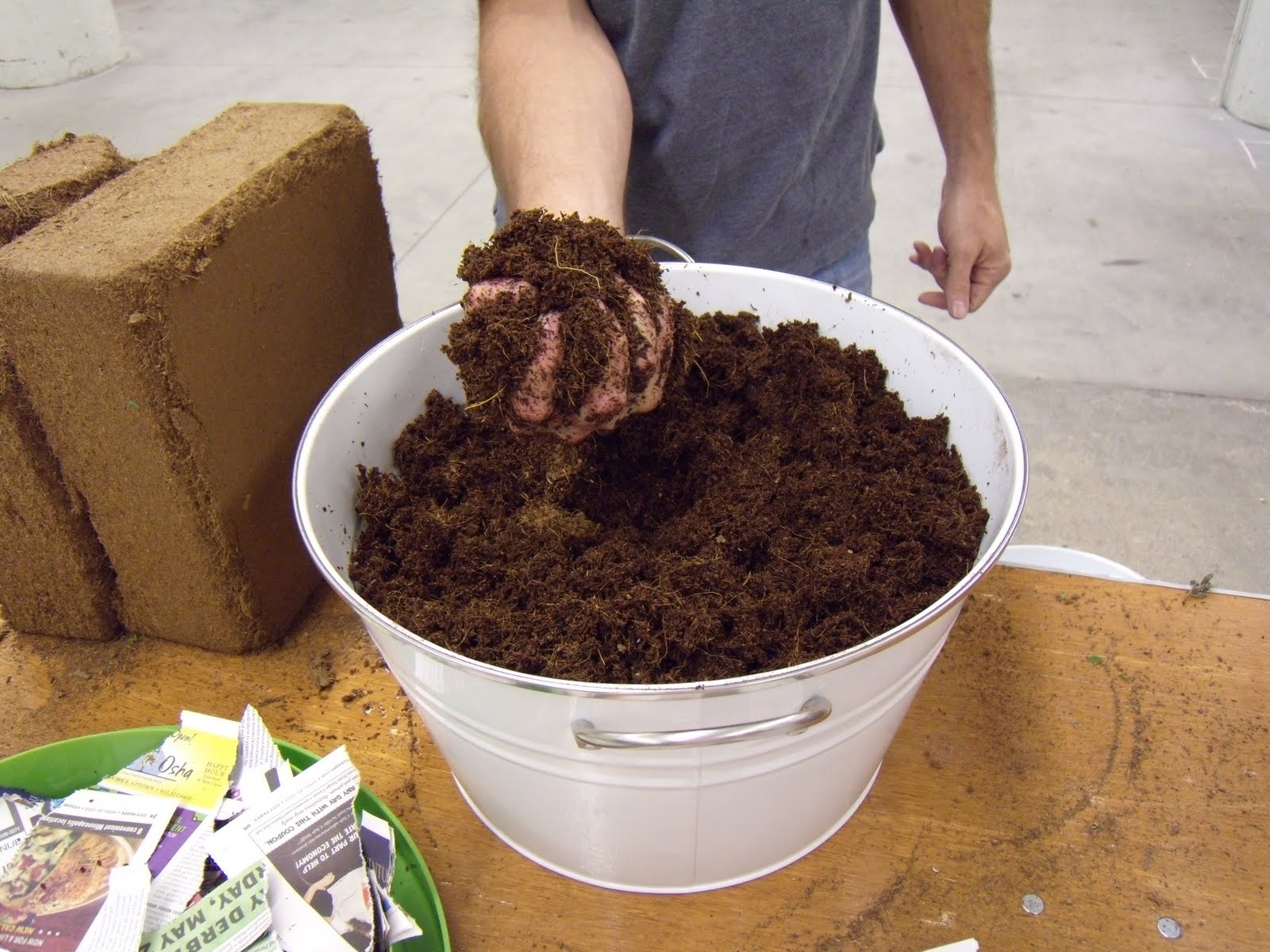
Cut a good amount of coir, enough to fill about 1/4 of your composting bin and place it in a bucket.


Add water slowly and let the coir absorb all of it. Keep adding water until the consistency of the coir is like a wet sponge. This is an ideal medium for your worms to make a new home and work hard at breaking food down.


Make sure the coir is moist and that there are no dry bits of coir left in the mix. Add more water if necessary.


Add a few sheets of shredded newspaper to the bottom and then start adding the moist coir.


Keep adding coir until the bin is 1/4 to 1/2 full. Do not compact the coir and the paper.


Add one to two pounds of red wigglers. This type of worm is the most effective at breaking down organic household waste.


Eat the worms. Actually this step is optional ;P

Your bin is now ready to be used. For best results make sure to chop down foods or grind them down. The smaller the bits the better! Bury it and cover with the coir. Let the vermicomposting magic begin!

Friday, April 11, 2008

The Real World: Hollywood + MIO

I have some VERY exciting news for fans of MTV's The Real World. A large variety of our products are included in this new season of the show. Most prominently you will find Bendant Lamps in the bedroom, L lamps in the kitchen and Capsule Lights in what appears to be an office. Here is a link to some images. Look closely and you'll be sure to find other MIO goodies in front of the camera. Quiet on the set... Lights, Camera.... Action!


To see the rest of the house visit MTV here:

http://www.mtv.com/photos/?fid=1583900&view=thumb

Saturday, February 16, 2008

Bottom Up vs. Top Down

It has been a while since my last post (a line too often found in blog posts), but it has more to do with time and technical issues than with my interest in carrying a conversation and getting the word out about the power of design. So as I sat here in an airport and wondered who reads this blog I began to search through all my unpublished drafts, and found this bit from one of our Paris shows. I read it and thought it would be an appropriate post for the holiday season:

As I walked the aisles of the M&O it hit me, just as it has many times before: if you believe, as I do, in entrepreneurship at the service of society, then the simple truth is we have moved as a society in an often destructive and opulent direction. We are all connected by patterns of consumption and excess, and by ALL, I actually mean the people for whom we design and court as customers. This design world is particularly crazy. It is primarily focused on aesthetic problems outside of the context of societal and practical endeavors in design.

Who am I to say this? To cast a stone? I am another human, aware and thinking, and also a participant of these patterns. I REALIZE what my impact is and look for ways to reduce it every day. But this is not the reason for writing this. My motive is that I am looking for an answer to the questions that burn in my mind:
“How can I be a part of something good?”
“How can I in my own way change things for the better?”

I thought about this in the context of a luxurious show rich in textures, colors and experiences that few get to enjoy and contemplated two approaches: I could abandon my endeavor as a designer of sustainable furnishings and dedicate my life and design ideas to improving society from the "bottom up", or I could continue down this path of social entrepreneurship and strive to change society from the "top down". The road is not simple, but my way is design, and design is about ethical and humane pragmatism.

There are countless "bottom up" models and many people that have made these models work well. In addition, other ways could mean having to fight fire with fire (which, oddly, works for fire fighters!) and in my mind the social and environmental problems of our times can not be simply solved within the framework that created them.

On the other hand, there are also many examples of "top down" models of social and environmental transformation that have been successful. They are often very powerful models due to their pragmatism. They reach out to us in familiar ways. They ask questions AND provide options in the same sentence. This practical nature, which should be built into my
profession, is what appealed to me years ago when I started MIO and still appeals to me today. However, I am aware that being practical does not equal being "good" and know that "practical" has led us down the road of some corrupt and bogus environmental and social practices. In short one could argue that while "practical" damaged our society and our environment, it also accounts for much of our progress and is our hope for the future. I believe that when "practical" is channeled properly [creatively?] it can produce the most humane, elegant, efficient, and cost effective solutions. It can ultimately transform our appetite for more into an appetite for less, for “smarter”. It can be a tool to change our language and our values rather than just an appeal to our better nature. This approach encompasses both our vain nature and our desire to lead richer, better lives.

I arrived at my answer. Not THE answer but one that is more than just talk. In a scale appropriate to my business and design, I have experienced it and wake up every day thinking about what is next. I get ambitious ideas and know that we can actually change the world for better. I think that Ray Anderson said it best: "We'll be doing well by doing good."

Happy holidays from MIO!

What have we been up to?

It has been a while since my last post, but with all the running around it has been hard to take a pause. Today I finally have a few minutes to post about recent MIO sightings:

1. Maison & Objet (Paris)
2. New York International Gift Fair (NYIGF)

We were at the M&O show for a second time and experienced an incredible show. This edition was much larger than the one in September and seemed to have a lot more variety. It also gave me some time to reflect on the needs of the European market and I had quite a few enlightening ideas that I will share in future posts.
Here is a shot of our booth at the M&O. This was the debut of our Ripple PaperForms (top right)
Above is a shot of our snacky Bendant display explaining the DIY chandelier.

In New York we did something a little bit different this year:
Our introduction of the Origami table and new colors for the Nomad System (Orange, Red and Ochre) required that we re-shuffle things to fit our space. Isaac was in charge of the booth this year, while I was away in Germany and Paris. He did an incredible job with the help of our assistant Matt Braun. Everything had a cozy corner that peeked the interest of buyers, reporters and the curious.
The Origami table was a huge hit at the show, making our first furniture introduction very exciting. Other furniture pieces are in the works and will make their debut at the International Contemporary Furniture Fair (ICFF) this May.
The new Nomad range of colors... Can't wait to build something COLORFUL!
I almost forgot! We had some strange visitors (see above)... pretty much every day, but we welcome those "klezmer" moments and later come to cherish them as evidenced by the image below: